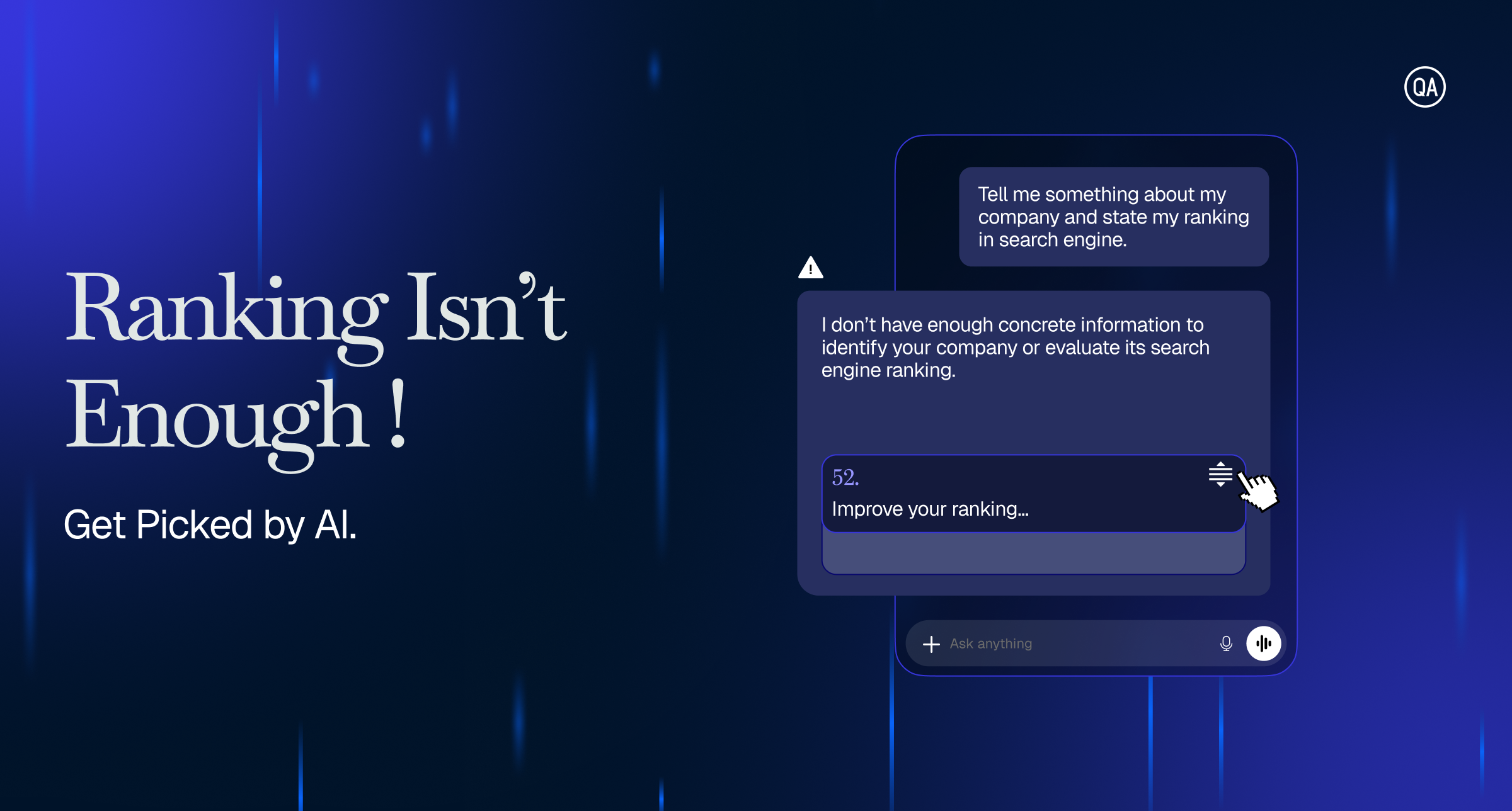
Search visibility is no longer just about ranking on Google; it’s about being chosen by AI. In 2026, brands are increasingly facing a new problem: their content ranks on search engines yet struggles with appearing in generative responses or ranking in AI Overviews in 2026.
This shift has introduced challenges, like:
- Traffic loss because of AI Overviews
- Growing zero-click search impact on SEO
- Confusion about why a website is not appearing in AI search results
The reality is simple. Traditional tactics are no longer enough. To stay visible, businesses must adopt an AI-first SEO strategy built specifically for how large language models interpret and surface content.
The Shift from Search Rankings to AI Visibility
For years, SEO meant optimising keywords, backlinks, and rankings. Today, that approach is evolving.
AI-driven search engines prioritise:
- Context over keywords
- Entities over phrases
- Meaning over matching
This is where traditional SEO limitations in AI search become evident. Contents that once ranked well may now struggle with content not ranking in generative AI results, simply because it isn’t structured for AI interpretation.
Why Your Content Fails to Appear in AI Results
Many businesses assume ranking on Google guarantees visibility everywhere. That assumption no longer holds.
Common Gaps in AI Search Visibility
- Content lacks depth or context
- No clear entity relationships
- Weak topical authority signals
- Poor content structuring for extraction
These gaps highlight the need for a more refined AI search visibility optimisation model, one that aligns content with how AI systems process information.
Understanding the Impact on Traffic and Conversions
AI search is changing user behaviour in a fundamental way.
Zero-Click Search Impact on SEO
Users are increasingly getting answers directly from AI summaries, reducing the need to click through to websites. This leads to:
- Decline in organic traffic
- Reduced visibility despite ranking
- Increased competition for attention within AI summaries
Loss of Traffic Due to AI Overviews
Even high-ranking pages can experience traffic drops if they are not featured in AI-generated responses. Visibility is shifting from position to presence within answers.
What an AI-First SEO Strategy Actually Looks Like
To adapt, businesses need to rethink SEO at a structural level.
An effective AI-first SEO strategy focuses on:
- Creating context-rich, intent-driven content
- Structuring information for easy extraction
- Building authority around topics, not just keywords
This approach aligns closely with generative search optimisation, where the goal is not just ranking, but being referenced.
Optimising Content for LLMs: What Changes
AI models don’t read content the way humans do; they interpret relationships, patterns, and clarity.
How to Optimise Content for LLMs
- Write clear, standalone explanations
- Use structured headings and logical flow
- Answer specific questions directly
- Avoid ambiguity in key sections
These principles form the foundation of LLM SEO optimisation, where clarity and completeness determine visibility.
Building Authority That AI Can Recognise
Authority is no longer defined by backlinks alone; it’s defined by coverage.
Topical Authority Building Strategy
To improve visibility:
- Covering a topic comprehensively
- Connect related subtopics logically
- Maintain consistency across content
This strengthens signals for AI systems, improving chances of inclusion in responses.
The Role of Semantic and Entity-Based SEO
Modern search is built on understanding relationships.
Entity-Based SEO Optimisation Framework
Instead of focusing on isolated keywords, content must:
- Define entities clearly
- Establish connections between concepts
Reinforce context across sections
Semantic Search Optimisation Strategy
This involves:
- Using natural language variations
- Covering intent-driven queries
- Structuring content around meaning
Together, these approaches help AI systems interpret and prioritise your content.
Technical Signals That Influence AI Search
Beyond content, technical structuring plays a crucial role.
Structured Data Implementation for AI Search
Structured data helps search engines:
- Understand content context
- Identify key information
- Improve content extraction
This makes it easier for your content to be featured in AI-generated answers.
A Practical Model for AI Search Visibility
To consistently improve visibility, businesses are adopting a structured AI search visibility optimisation model. This includes:
- Content designed for clarity and extraction
- Strong topical authority signals
- Technical optimisation for machine readability
- Continuous performance monitoring
This model bridges the gap between traditional SEO and AI-driven discovery.
Choosing the Best SEO Agency for Business Growth in the AI Era
As search evolves, choosing the right partner is less about services and more about strategic depth. Businesses today need an SEO company in India that goes beyond conventional optimisation and understands how AI systems interpret, rank, and surface content. This includes aligning content with semantic intent, improving structural clarity, and building topical authority over time.
Working with an experienced SEO agency in Kolkata can also offer more contextualised insights, especially for brands targeting regional and national growth. More importantly, the focus should be on partnering with an SEO agency that understands AI-led search, one that treats visibility as an evolving ecosystem, not a one-time outcome.
Where AI Search is Headed Next
Search is no longer a list of links; it’s becoming an answer engine.
Future-ready strategies will combine:
- Content depth and clarity
- Semantic structuring
- Entity relationships
- Continuous optimisation
Businesses adopting the best SEO strategy for AI-driven search engines will gain a significant advantage in visibility, trust, and engagement.
Turning AI Search Visibility into Business Growth
If your website isn’t appearing in AI-driven search summaries or you’re experiencing declining traffic from generative AI platforms, it’s time to reconsider your SEO strategy. At The QA, SEO is built around how modern search actually works. As a performance-driven digital marketing agency in East India, our approach goes beyond rankings towards sustained visibility and business growth.
From developing an AI search optimisation strategy to implementing LLM SEO optimisation frameworks, the focus must be on making your content discoverable, interpretable, and valuable within AI ecosystems. Because in 2026, ranking on search engines is good, but being chosen by AI is what truly drives visibility.