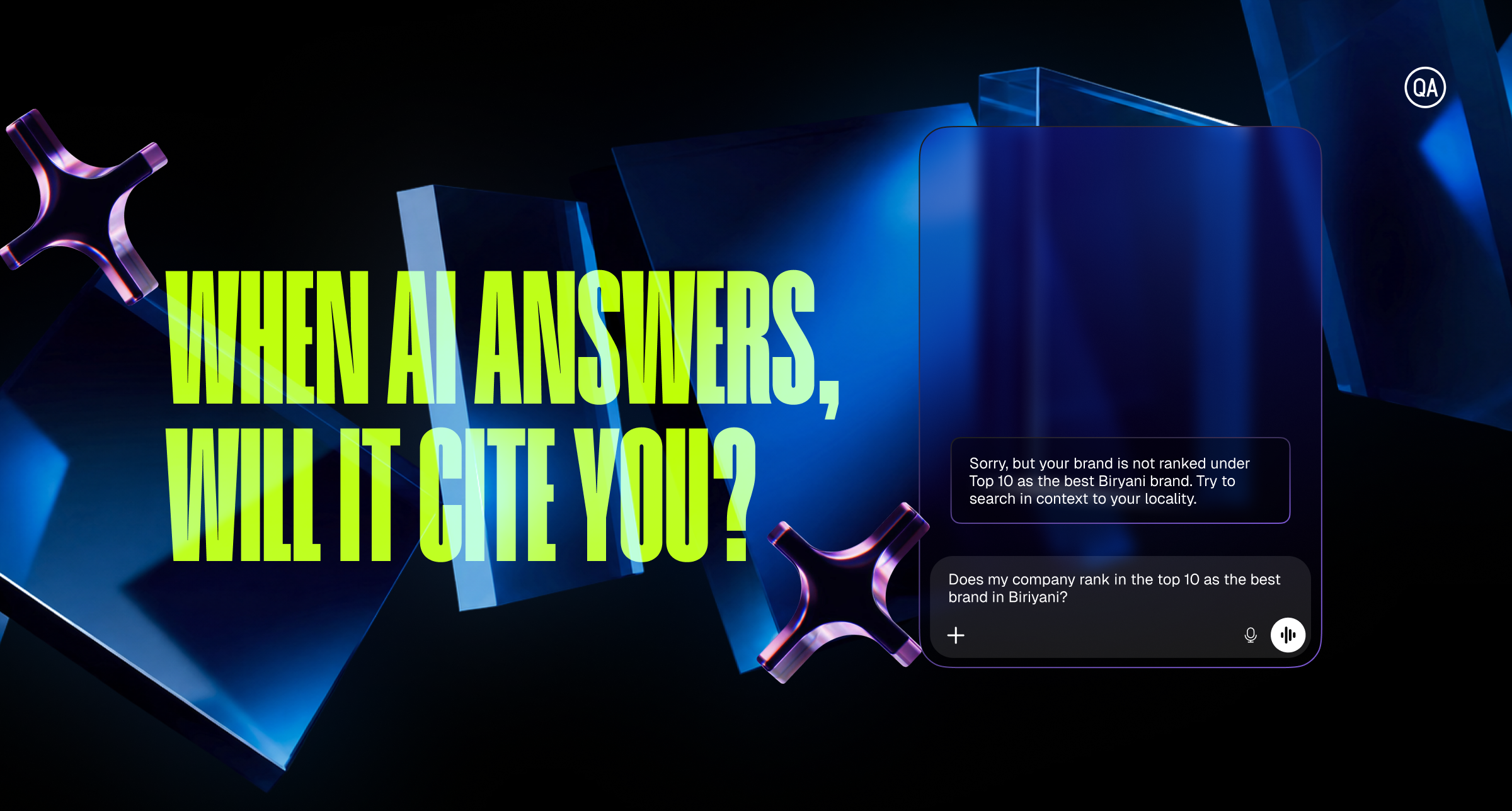
For two decades, search logic has been linear, focusing on ranking, clicks, and conversions. However, this approach is under pressure due to AI-powered platforms like Google AI Overviews, ChatGPT, Perplexity, and Gemini, which now provide synthesised answers before users reach search results. Businesses that relied on traditional rankings are realising that ranking in search results and being recognised as a credible source are distinct outcomes.
The shift is not towards eliminating search, but rather towards trusting AI-generated answers. Consequently, AI search optimisation has become crucial for brands to ensure they are recognised by decision-makers.
This article discusses how AI systems evaluate authority, necessary changes for businesses, and emphasises the urgency for action within the available timeframe.
Why Is AI Fundamentally Changing Search Visibility?
Generative AI search optimisationfundamentally differs from traditional SEO, which focused on ranking lists for user decision-making. In contrast, AI search generates synthesised responses, drawing from various sources to present conclusions without necessitating user clicks, epitomising zero-click search optimisation where answers themselves are the destinations.
Consequently, businesses might occupy page-one rankings yet remain unrecognised by AI systems, raising a competitive challenge: the focus is no longer on page visibility but on whether AI identifies the brand as a credible, citable source in its responses.
Search visibility beyond Google is no longer a secondary consideration. The surfaces businesses can no longer afford to ignore include:
- Google AI Overviews: Now appearing across a growing share of informational and commercial queries
- ChatGPT: Handling hundreds of millions of intent-driven queries weekly, with a significant proportion from business decision-makers
- Perplexity: Increasingly preferred by professionals, researchers, and senior buyers
- Gemini and Claude: Gaining adoption across enterprise and business contexts
A brand absent from these surfaces is absent from a significant and growing segment of its audience’s decision-making journey.
What Do AI Systems Actually Evaluate When Selecting Sources?
Understanding AI search ranking factors involves recognising a fundamental shift in evaluation criteria, moving away from traditional metrics like keyword density, backlink volume, and domain age.
Instead, modern approach built on LLM SEO optimisation focus on semantic clarity, topical depth, and logical coherence, emphasising the importance of creating content that answers specific questions rather than merely fulfilling word count requirements in answer engine optimisation. An effective entity SEO strategy now includes establishing brands and entities clearly on the web, highlighting entity SEO as a crucial component of contemporary search effectiveness.
What AI systems are actually looking for:
- Entity SEO strategy: Consistent, clearly defined representation of your brand and expertise across your website, third-party references, and structured data
- LLM SEO optimisation: Semantic precision and conceptual depth rather than keyword frequency
- Answer engine optimisation: Content that answers a specific question completely within a self-contained section
- AI overview optimisation: Paragraphs and sections structured to be extracted and presented independently without losing meaning
- Brand authority SEO: Sustained, original, credible content within a clearly defined domain of expertise
Businesses still measuring AI search performance through a legacy SEO lens are not just behind; they are measuring the wrong outcomes entirely.
How Should Businesses Build Authority for AI-First Search?
Content optimisation for AIfocuses on structural quality and semantic authority rather than merely increasing content quantity. AI can differentiate between comprehensive coverage and authentic expertise, impacting citation selection. Content that merely explores topics without a clear stance or elaborates on obvious information fails to build citation trust.
A practical framework for building AI citation authority:
- Define your entity clearly: Ensure your brand, core services, and expertise areas are consistently described across your website, structured data, and third-party mentions.
- Build topical depth, not breadth: Cover fewer subjects with greater authority rather than producing surface-level content across every category.
- Structure content for extraction: Each major section should be self-contained, directly addressing one question, and logically complete without requiring surrounding context.
- Maintain genuine editorial standards: Content that takes a position, demonstrates experience, and offers original interpretation earns citation trust. Content that restates publicly available information does not.
- Sustain consistency over time: AI trust is cumulative. A single strong article is insufficient. These systems evaluate the pattern of authority across an entire domain.
Businesses must understand that how to rank in AI search is not a one-time optimisation task. It is a long-term commitment to being the most credible source within your domain, which is a significantly higher bar than being the most keyword-optimised page.
What Mistakes Are Businesses Making Right Now?
The gap between organisations building for AI visibility for their businesses and those still optimising for outdated signals is widening, and it compounds over time. Several patterns consistently hold businesses back from meaningful AI citation presence.
Warning signs your current strategy is not built for AI-first search:
- Measuring success exclusively through keyword rankings and organic traffic, with no evaluation of AI citation presence
- Producing content at volume without a clear entity or topical authority strategy behind it
- Treating SEO for AI search as a future agenda item rather than a present operational priority
- Relying on historical domain authority without updating content structure for AI extractability
- Ignoring the surfaces – Perplexity, ChatGPT, Gemini – where an increasing share of business decision-makers are already forming opinions
The future of SEO in 2027 demands proactive engagement. Businesses that delay focusing on SEO will struggle to close the competitive gap established by early adopters who have built significant authority over time.
The Businesses That Move First Will Define the Next Benchmark
Citation authority in AI search evolves unevenly, with systems deriving recognition from established credibility signals. Companies producing structured, semantically authoritative content gain lasting advantages, making it harder for latecomers to compete.
The QA builds search authority tailored for an AI-first environment, moving beyond traditional keyword strategies to encompass entity recognition and content architecture, emphasising the brand authority SEOthat AI systems assess for citation trust. As a specialised SEO agency in India focusing on AI SEO services, we start by analysing your brand’s current perception across AI platforms and determining the requirements for achieving a consistent citation presence. If you aim to establish search authority aligned with future trends, consider our SEO services.