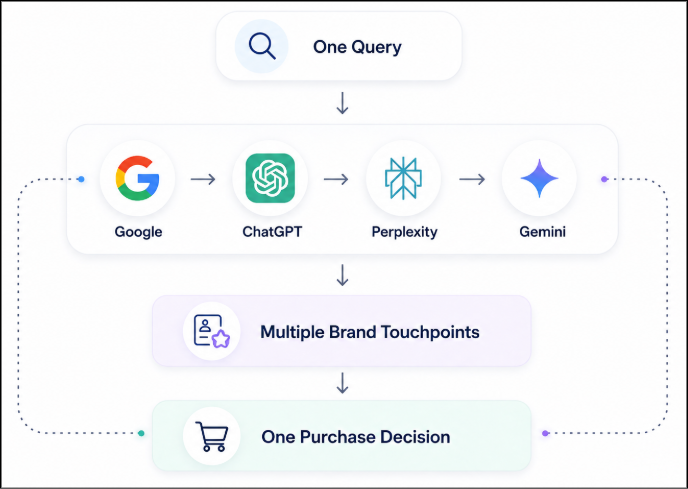
Search has not disappeared; it has multiplied. Users are no longer choosing between Google, ChatGPT, Perplexity, and Gemini. They use all of them, often within the same decision process. A question asked on one platform gets refined on another, and the brand that appears consistently across all of them holds a structural advantage over competitors that appear on just one platform.
AI search optimisation is no longer a forward-looking strategy. It is the current operating reality for any business serious about search visibility. The businesses that understand this now will define the reference points that everyone else is measured against.
The New Search Journey
What Has the Search Landscape Actually Become?
Understanding the future of SEO starts with accepting what search no longer is. It is not a single platform, a single algorithm, or a single set of ranking signals. Google AI Overviews, ChatGPT, Perplexity, and Gemini each pull from different signals, evaluate content differently, and reach overlapping but distinct audiences.
Zero click search has changed the economics of visibility. A growing share of queries is now resolved directly within the platform – no click required. A brand can rank well on a results page and still remain commercially invisible if it is not the source that AI surfaces in its synthesised answer.
The platforms businesses can no longer afford to ignore:
- Google AI Overviews: Appearing across a growing share of informational and commercial queries.
- ChatGPT: Handling billions of intent-driven queries monthly, with a significant share from business decision-makers.
- Perplexity: Preferred by professionals and researchers who need source-cited, direct answers.
- Gemini: Gaining adoption across enterprise and productivity contexts.
A brand absent from these surfaces is absent from a meaningful portion of its audience’s decision-making journey.
Why Is Traditional SEO No Longer Enough on Its Own?
Traditional SEO still matters – but it is now one component of a larger system, not the whole system. Businesses treating rankings as the endpoint are optimising for a fraction of the platforms where their audience is actually searching.
| Traditional SEO Rewards | AI Search Rewards |
|---|---|
| Keyword relevance | Semantic depth and context |
| Backlink volume | Entity authority and trust |
| Page rankings | Citation and source selection |
| Click traffic | AI visibility and mentions |
| Content volume | Structured, extractable answers |
Topical authority bridges both worlds effectively. It satisfies traditional ranking signals while demonstrating the kind of focused expertise AI systems select when assembling a response. Neither approach alone delivers sustainable search visibility.
What Signals Do AI Search Systems Actually Evaluate?
This is where AI SEO diverges most sharply from conventional practice. AI platforms do not simply match content to a query; they assess whether your brand is a trustworthy source worth including in a synthesised response. These signals fall across three distinct areas.
How Your Brand Is Represented Across the Web
Entity SEO is the foundation. AI systems need to clearly understand who you are, what you do, and what areas of expertise your brand genuinely owns – across your website, structured data, and any third-party platform where your brand appears. Knowledge graph optimisation extends this: the more consistently and accurately your brand is represented in structured knowledge systems, the more confidently AI platforms can reference it. Without this foundation, even strong content struggles to earn consistent citation.
How Your Content Is Structured and Understood
Semantic SEO determines whether your content demonstrates genuine understanding of a topic or simply applies keyword coverage superficially. Content that explores a subject in depth, addresses related questions, and organises information clearly is far more likely to be cited than content that matches a keyword while offering little beyond it. This is one of the clearest dividing lines between content AI systems trust and content they pass over.
How Citation Trust Is Built Over Time
AI citation optimisation is not a technical fix; it is an accumulated outcome. It reflects the pattern of credibility signals that lead AI systems to consistently select your brand as a reference source across different queries. Optimisations for generative engine and AI overview operate on the same logic be the most reliable source on a topic, not just the most visible page. This kind of trust compounds over time. The brands building it now are establishing advantages that will be structurally difficult for others to close.
How Should Businesses Build a Strategy for AI-First Search?
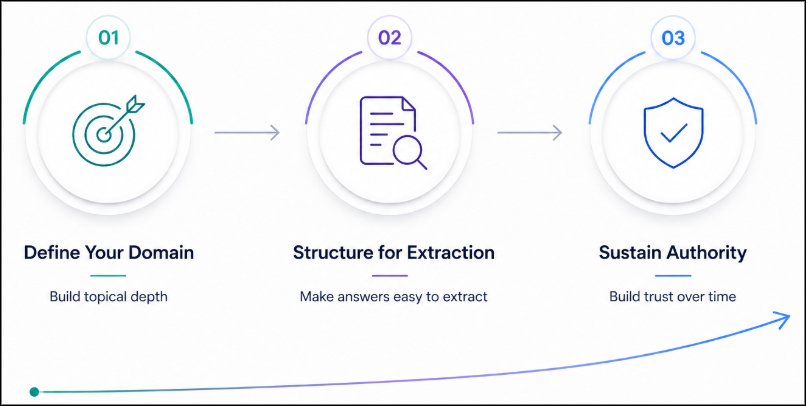
AI systems reward what search has always theoretically valued – genuine expertise, clear communication, and consistent authority. The difference now is that they can measure it with far greater precision. A strategy that holds across Google and AI platforms rests on three interconnected disciplines.
AI-First Search Strategy
Define Your Domain and Build Depth
Cover fewer topics with greater authority. Scattered content across unrelated subjects undermines both traditional rankings and AI citation potential. AI SEO gains are built by concentrating on a defined area of expertise and developing comprehensive, original coverage within it – not by publishing broadly across every category the business touches. Focused depth signals domain authority in a way that AI systems recognise and reward.
Structure Every Section for Extraction
Every piece of content should be built around search intent optimisation – what a specific user is actually trying to resolve, not what keyword they typed. Each section should open with a direct answer to the question its heading poses and structured for independent extraction – complete and accurate without surrounding context. This approach works for human readers and AI systems simultaneously, which is precisely the point.
Sustain Authority as a Long-Term Practice
A single strong article does not earn AI citation trust – a sustained pattern of credible, well-structured content does. Consistent attention to LLM SEO principles – logical flow, semantic clarity, and self-contained sections – builds the kind of domain-level authority that AI systems consistently recognise and reward. What functions as a differentiator today is likely to become a baseline expectation within the near future.
The Brands That Appear Everywhere Will Set the Standard
The future search strategy is not about choosing between Google and AI platforms; it is about building authority that works across all of them, because that is where decisions are now being made. Brands establishing this kind of multi-surface presence now are creating benchmarks that competitors will find increasingly difficult to reach later.
The QA builds search strategies designed to work across traditional rankings and AI-powered surfaces – spanning entity optimisation, structured content architecture, and the kind of topical depth that AI systems evaluate when selecting sources. As a specialist SEO agency in India with focused capability in AI-native search strategy, the work begins with understanding where your brand currently stands across these surfaces. Explore our SEO services to see how that translates into practice.
Questions Worth Asking Before Your Competitors Do
Is SEO dead now with AI?
No; SEO has evolved, not ended. Traditional rankings still matter but now form part of a broader system. Credible AI search optimisation agencies are already building strategies across Google, ChatGPT, Gemini, and Perplexity. Businesses treating each platform separately are leaving meaningful visibility gaps open.
How to rank in ChatGPT search results?
ChatGPT favours content built around answer engine optimisation principles – sections that fully resolve one question independently. Consistent brand mentions on the reputable third-party platforms further strengthen the likelihood of being cited in generated responses.
Is SEO actually worth it?
Yes. Businesses investing in SEO and AI SEO services are building credibility across both traditional search and AI-powered surfaces simultaneously. The returns compound over time – making it one of the highest-leverage investments in sustainable digital growth.